

The Hidden Cost of Shadow Systems
Why those rogue spreadsheets and workaround tools are doing more harm than you think

In many organizations, especially those with legacy systems or fragmented platforms, a quiet phenomenon creeps in: shadow systems.
They’re not inherently evil. They’re often born out of necessity. But they come with a cost. One that compounds over time.
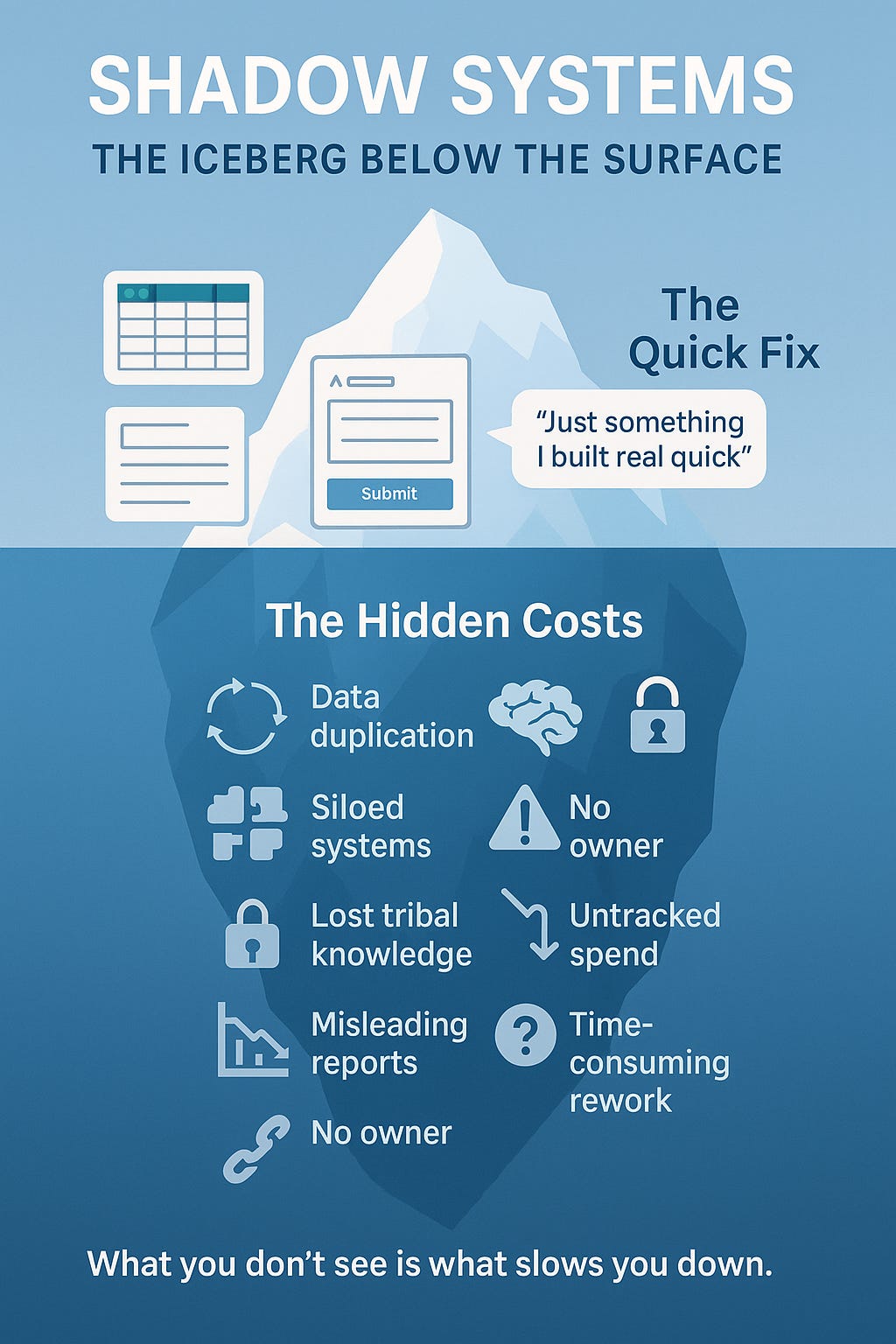
Shadow systems are unofficial tools, like spreadsheets, Access databases, ad-hoc web forms, or even full-fledged SaaS tools; created or maintained by business units outside IT’s purview to fill gaps in core systems.
Let’s dig into what makes these tools so appealing, what risks they introduce, and how organizations can shine a light on them without crushing agility.
Why Shadow Systems Emerge
If you're seeing these pop up across departments, it’s not always a sign of rebellion. It's often a signal of misalignment or unmet needs:
Slow IT cycles: When a formal request takes months to implement, teams fill the gap themselves.
Legacy limitations: Core systems can’t handle specific workflows or reporting needs.
Specialized processes: Edge-case needs not supported by enterprise systems require niche solutions.
Data silos: Users don’t trust the existing systems, or the data isn’t structured the way they need it.
Shadow systems emerge as a form of operational survival. But that doesn’t make them sustainable.
The Risks Beneath the Surface
Here’s where the hidden costs start stacking up:
1. Data Integrity Breakdowns
Spreadsheets don’t enforce data validation. Custom tools aren’t integrated with the SSOT. Shadow systems create:
Conflicting versions of truth
Manual re-keying and copy/paste workflows
Inconsistent business logic across teams
2. Security and Compliance Gaps
IT isn’t monitoring or maintaining these systems. That leads to:
PII or financial data in unsecured tools
Missed audit trails or retention policies
Shadow vendors with unclear security postures
3. Redundant and Misaligned Work
Teams build their solutions because they don’t know whether others have already solved the same problem.
Duplicate efforts in different departments
Redundant license costs for point solutions
Misaligned workflows that never connect
4. Tech Debt with No Owner
Nobody officially owns the upkeep. When the creator leaves or the business changes:
Processes break silently
Tribal knowledge is lost
IT inherits the mess with no context
Real-World Contact Center Example
In a mid-sized contact center, the official CRM couldn't support a specific form of alumni outreach tracking. So a team lead built an Excel tracker and shared it across reps via Teams.
What happened:
The spreadsheet ballooned to 15+ columns
Filters and conditional formatting broke the file
Agents entered data inconsistently
The manager lost track of which version was the most current
Meanwhile, leadership pulled CRM data, assuming it was the full picture
The impact? Poor reporting, disconnected outreach, and misinformed decisions on what channels were working.
💡 Why This Happens More Than You Think
Organizations often accidentally reward shadow systems:
Team members who “just make it work” are seen as scrappy
Business units praise fast fixes over sustainable solutions
Leaders are more focused on outcomes than process integrity
It’s not about blaming those who build these tools. It’s about understanding that clever workarounds don’t scale—and shouldn’t be the long-term solution.
What Product and IT Teams Should Do
Instead of cracking down, redirect that shadow system energy into the light.
1. Start with Discovery, Not Discipline
Catalog the most common shadow tools
Understand the need each tool is solving
Interview users. What made them bypass official systems?
2. Prioritize by Risk and Frequency
Some shadow systems are harmless. Others pose a major risk.
Focus remediation efforts where risk and business value are highest.
3. Build a Better Path
Create clear intake paths for new functionality
Offer no-code/low-code platforms with governance
Embed product managers or analysts with business teams to anticipate needs early
4. Make System Enhancement Easier than Shadow Building
If your intake is complex and slow, shadow systems will win
Streamline enhancement approval and clarify timelines
Communicate “why” when ideas can’t be implemented right away
Shadow Systems as a Strategic Signal
When viewed correctly, shadow systems are like warning lights. They tell you:
Where your core platforms are falling short
Where internal enablement isn’t working
Where autonomy has outpaced alignment
Don’t ignore them. Don’t punish them. Translate them into fuel for your roadmap.
Final Thought
Every time you discover a rogue spreadsheet, ask yourself this:
What process, system, or communication failure created the need for this?
The answer isn’t always to eliminate the tool. Sometimes the answer is to bring it into the fold, properly governed, fully supported, and aligned with the broader tech ecosystem.
Because in the long run, the true cost of shadow systems isn’t just operational, it’s strategic.